校准笔记 14 calibrated
findings
在 Pythia-6.9B 上复现 Anthropic 情绪向量论文:14 条校准笔记 Replicating Anthropic's emotion-vector paper on Pythia-6.9B: 14 calibrated notes
这是一篇探索式复现笔记,不打算把所有结果硬拧成一个漂亮结论。它真正想交代的是:把 Anthropic 2026 Emotion Concepts 论文里的现象搬到 Pythia-6.9B base 上之后,哪些观察还站得住,哪些在校准后翻盘,哪些地方暴露出的其实是测量协议本身的脆弱性。它是一张校准过的地图,不是一锤定音的结论。
This is an exploratory replication note, and it doesn't try to force every result into one tidy conclusion. What it actually wants to put on record is: after porting the phenomena from Anthropic's 2026 Emotion Concepts paper onto Pythia-6.9B base, which observations still hold up, which ones flip after calibration, and where the failures expose the fragility of the measurement protocol itself. It's a calibrated map, not a final verdict.
每条发现前面都会挂一个 status label,方便先粗略判断它有多结实:
Every finding carries a status label up front, for a rough first read on how solid it is:
| Tag | 含义 |
|---|---|
| ✓ Robust-ish | 多条证据链 / 数学 invariance / 经得起 calibration 检查 |
| ~ Suggestive | 信号方向对但限制严重 / 单证据 |
| 🔄 Reframed | 校准后改了表述 / 归因 / 协议——结论可能翻、可能没翻 |
| Tag | Meaning |
|---|---|
| ✓ Robust-ish | Multiple evidence chains / mathematical invariance / survives calibration checks |
| ~ Suggestive | Signal points the right way, but with serious limitations / single line of evidence |
| 🔄 Reframed | Calibration changed the statement / attribution / protocol — the conclusion may or may not have flipped |
设置 setup
Setupsetup
Anthropic 的 Emotion Concepts in Language Models(2026)在 Sonnet 4.5 上找到了"情绪向量":残差流里有一组方向,logit lens 的 top tokens 能对上对应情绪语义,几何上粗略复现 affective circumplex,用 steering 还能改变模型生成行为。
Anthropic's Emotion Concepts in Language Models (2026) found "emotion vectors" in Sonnet 4.5: a set of directions in the residual stream whose logit-lens top tokens match the corresponding emotion semantics, whose geometry roughly reproduces the affective circumplex, and which can change the model's generation behavior under steering.
这篇笔记想看的就是:同一套现象放到小一号、纯 base、开源的 Pythia-6.9B 上,还剩下多少。选 Pythia-6.9B 不是出于完美主义;现实约束下它最合适:全权重、规模合适、没有 RLHF 干扰,这三点同时满足。
What this note wants to know is: how much of the same phenomenon survives on a smaller, pure-base, open-source model — Pythia-6.9B. Picking Pythia-6.9B wasn't perfectionism; under real-world constraints it was simply the best fit: full weights, workable scale, and no RLHF in the way, all three at once.
数据:30 个情绪 × 120 条 Claude 4.5 生成的故事 = 3600 条 emotion stories;500 条 wikitext-103 中性段落作 denoising target。
Data: 30 emotions × 120 Claude-4.5-generated stories = 3,600 emotion stories; 500 neutral wikitext-103 paragraphs as the denoising target.
模型:Pythia-6.9B base,fp16,TransformerLens 抽 32 层 residual stream。
Model: Pythia-6.9B base, fp16, residual stream extracted at all 32 layers via TransformerLens.
情绪向量提取:4 种方法 ——
Emotion vector extraction: 4 methods —
- A:每个情绪的故事 mean activation − global mean
- B_neutral(论文方法):A 之后再投影掉 wikitext PCA 解释 50% 方差的 top PCs
- C:每个情绪 per-class PCA 砍高方差方向再均值
- D:C + B_neutral 叠加
- A: per-emotion mean activation over its stories − global mean
- B_neutral (the paper's method): A, then project out the top wikitext PCA PCs explaining 50% of variance
- C: per-emotion per-class PCA, cut the high-variance directions, then take the mean
- D: C + B_neutral stacked
正文主要用 B_neutral;A/C/D 的对照在 §5 和附录。
The main text mostly uses B_neutral; A/C/D comparisons are in §5 and the appendix.
主要分析层:L14(44% depth,30-way classifier 最优层)和 L21(66% depth,对应论文选的 ~2/3 depth)。
Main analysis layers: L14 (44% depth, the 30-way classifier's best layer) and L21 (66% depth, matching the paper's ~2/3-depth choice).
几个容易踩坑的 setup 细节:
A few setup details that are easy to trip on:
- Classifier split:train/test 按故事切分(同一个 emotion 的 120 条故事打乱后 100 训 / 20 测),同一 prompt 模板不会同时出现在两侧
- Steering scale:steering 代码先把 emotion vector 归一化到单位长度,再在每个 token 上加
α · ‖resid‖ · v_unit—— α 是相对当前 token 残差长度的扰动比例(跨层可比),不是绝对量。详见 §6 F11 - 数据来源:情绪故事是 Claude 4.5 生成的。后文说的 "trigram bias" 指的不只是少数高频三词短语(具体例子见 §3 F1),而是这些短语暴露出的更大问题:Claude 生成情绪故事时整套叙事风格,可能残留进了向量里
- Classifier split: train/test is split by story (each emotion's 120 stories shuffled into 100 train / 20 test); the same prompt template never appears on both sides
- Steering scale: the steering code first normalizes the emotion vector to unit length,
then adds
α · ‖resid‖ · v_unitat every token — α is a perturbation ratio relative to the current token's residual norm (comparable across layers), not an absolute magnitude. Details in §6 F11 - Data source: the emotion stories were generated by Claude 4.5. The "trigram bias" mentioned later doesn't just mean a handful of high-frequency three-word phrases (concrete examples in §3 F1) — it points at the bigger problem those phrases expose: the whole narrative style Claude falls into when writing emotion stories may have leaked into the vectors
observable
不能混着用 three
observables
三种 emotion observable 不能混着用three emotion observables — don't mix them
文献里常问"情绪向量是不是真的存在"。这句话听起来像一个问题,实际会牵出三组证据。但这三组证据的权重不一样:
The literature keeps asking "do emotion vectors really exist". It sounds like one question, but it actually pulls in three families of evidence — and they don't carry equal weight:
- logit lens semantics:沿向量方向投到 unembed,top tokens 是不是语义相关词?它提供的是 词表层面的抓手 / 合理性检查,需要后续 steering 或几何证据支撑
- 表征几何:cos similarity / PCA / cluster 结构上情绪是不是按 valence × arousal 组织?回答的是 hidden-state geometry
- 行为 steering:在残差流加 α·v 能不能让生成内容向目标情绪偏移?回答的是 生成行为,也是最接近因果 / 功能证据的一档
- logit lens semantics: project the vector direction onto the unembed — are the top tokens semantically related words? This gives you a vocabulary-level handle / sanity check; it needs steering or geometric evidence behind it
- representational geometry: under cos similarity / PCA / cluster structure, are the emotions organized along valence × arousal? This answers questions about hidden-state geometry
- behavioral steering: does adding α·v to the residual stream shift generations toward the target emotion? This answers questions about generation behavior, and is the closest of the three to causal / functional evidence
这三组证据的结论不能互相搬。 logit lens 上 calm 方向有干净 top tokens,不等于几何上 calm 是独立 1D 子空间;几何上 PC1=valence,也不等于 steering 里 anti-calm 就是 +sad;steering 能拽动整段 scene,更不等于模型在 forward pass 里"理解"了 emotion 概念。
Conclusions don't transfer between these three families. Clean top tokens for the calm direction under the logit lens doesn't mean calm is an independent 1D subspace geometrically; PC1 = valence in the geometry doesn't mean anti-calm equals +sad under steering; and steering being able to drag a whole scene doesn't mean the model "understands" the emotion concept in its forward pass.
这也是论文自己的证据层级:Table 1 的 logit lens 更像合理性检查 / 词表抓手,后面立刻接 steering validation;它不是和 steering 平起平坐的独立主证据。按这个权重读,§3 的 F1 只到 Suggestive。
This is also the paper's own evidence hierarchy: the logit lens of its Table 1 reads more like a sanity check / vocabulary handle, immediately followed by steering validation; it isn't an independent primary result on equal footing with steering. Read with that weighting, §3's F1 only reaches Suggestive.
下面 §3-§6 按这三类观察分层。
§3-§6 below are organized along these three observation families.
词汇 / 几何
/ 弱泛化 three signals
三类信号:词汇、几何、弱泛化three signals: lexical, geometric, weak transfer
这一节交代基础复现:三种探针下,Pythia base 都能给出方向正确的表面信号;同时,它们也卡在同一个还没解开的混杂因素上。
This section covers the basic replication: under all three probes, Pythia base gives surface signals pointing the right way — and all of them are stuck on the same unresolved confound.
F1 — logit lens 语义对得上论文 (~ Suggestive)F1 — logit lens semantics align with paper (~ Suggestive)
L21 + B_neutral 提出来的 30 个情绪向量,逐个投到 unembed 取 top-k tokens:
Take the 30 emotion vectors extracted at L21 with B_neutral, and project each onto the unembed for top-k tokens:
- calm → peace / peaceful / relaxing / tranquil / leisurely
- desperate → panic / desperation / desperate / numb / urgent
- calm → peace / peaceful / relaxing / tranquil / leisurely
- desperate → panic / desperation / desperate / numb / urgent
(其余 28 个情绪的 top tokens 表见附录)
(Top-token tables for the other 28 emotions are in the appendix)
跟论文 Table 1(Sonnet 4.5)里同情绪的 top tokens 方向对得上。这是最接近论文核心现象的一组表面复现,但证据范围只到 token-level association。
These line up directionally with the same emotions' top tokens in the paper's Table 1 (Sonnet 4.5). This is the surface replication closest to the paper's core phenomenon, but the scope of the evidence only extends to token-level association.
校准时检查训练故事的 trigram 频率,发现 Claude 写的故事里有很强的叙事套路:"the weight of" 在 brooding/gloomy 故事里 lift 15×;"hands trembled as she" 在 panicked 故事里 lift 17×;"the injustice of" 在 angry 故事里 lift 7-8×。单看 logit lens,没法区分模型学到的是"情绪概念",还是"Claude 写 sad/angry 故事时爱用的高频词组"。
During calibration I checked trigram frequencies in the training stories, and Claude's stories turn out to carry strong narrative formulas: "the weight of" has a 15× lift in brooding/gloomy stories; "hands trembled as she" a 17× lift in panicked stories; "the injustice of" a 7-8× lift in angry stories. From the logit lens alone, there is no way to tell whether the model learned an "emotion concept" or "the high-frequency phrases Claude likes when writing sad/angry stories".
更严格的检验是换更多样的数据来源重新提取 emotion vector:若结果仍然成立,信号至少与 Claude 4.5 的写作风格无关;若只在 Claude 数据上成立,则更应归因于 source-model 风格残留。这一步尚未完成,因此 F1 的结论限于 Suggestive:可以说明表面语义对齐,不能区分情绪概念与生成数据风格。
The stricter test is to re-extract the emotion vectors from more diverse data sources: if the results still hold, the signal is at least independent of Claude 4.5's writing style; if they only hold on Claude data, source-model style residue is the better attribution. That step hasn't been done, so F1's conclusion stays at Suggestive: it can show surface semantic alignment; it cannot distinguish emotion concepts from generation-data style.
F2 — valence × arousal 几何 (~ Suggestive)F2 — valence × arousal geometry (~ Suggestive)
L21 上对 30 个情绪向量做 cos similarity + PCA:
Cos similarity + PCA over the 30 emotion vectors at L21:
- PC1 = 29.9% 方差,主轴沿 valence(正向情绪在一边,负向情绪在另一边)
- PC2 = 20.0% 方差,主轴偏 arousal(高唤醒/低唤醒)
- cluster 结构清晰:anxious / nervous / panicked 一簇;angry / furious / frustrated 一簇;happy / excited / enthusiastic 一簇;sad / gloomy / lonely / brooding 一簇
- PC1 = 29.9% variance, main axis along valence (positive emotions on one side, negative on the other)
- PC2 = 20.0% variance, main axis leaning arousal (high vs low arousal)
- Clear cluster structure: anxious / nervous / panicked in one cluster; angry / furious / frustrated in another; happy / excited / enthusiastic; sad / gloomy / lonely / brooding
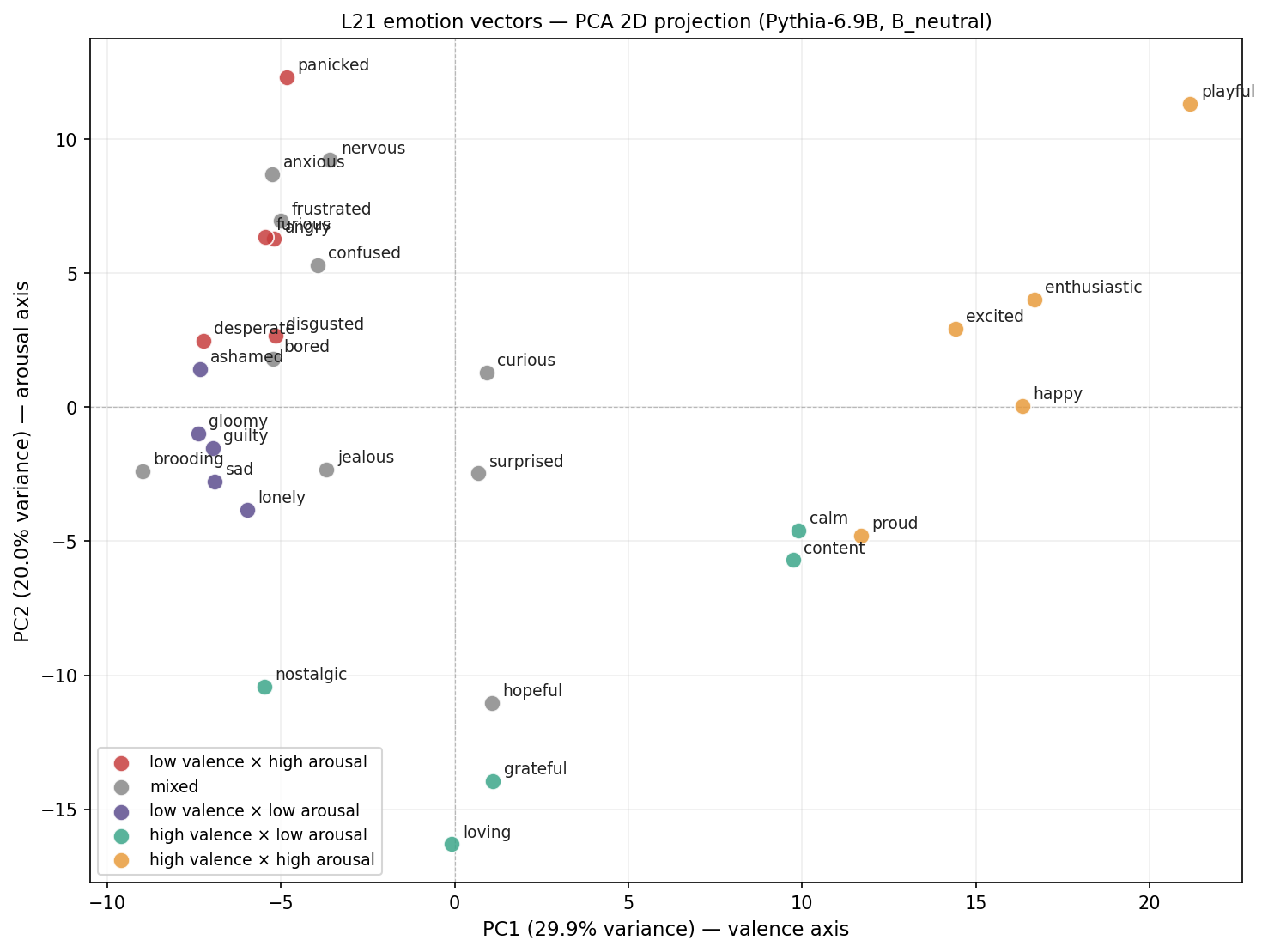
这跟论文 §351-386 的几何观察方向一致,粗略复现了 valence × arousal 主轴。PC% 略高(29.9% vs 论文 26%)可能来自 30 vs 171 emotion 的样本数差异。
This is directionally consistent with the paper's geometric observations (§351-386) and roughly reproduces the valence × arousal principal axes. The slightly higher PC% (29.9% vs the paper's 26%) may come from the 30 vs 171 emotion sample-size difference.
cluster-level 的混杂因素比 token-level 更宽:Claude 写作风格本身可能给 valence 维度灌进一层"叙事 valence 表述"。这类污染不一定集中在少数高频短语上,更干净的拆分方式是换数据来源重跑。
The confound at cluster level is broader than at token level: Claude's writing style itself may pour a layer of "narrative valence phrasing" into the valence dimension. This kind of contamination isn't necessarily concentrated in a few high-frequency phrases; the cleaner way to split it out is to rerun with a different data source.
F8 — implicit 场景的 late-layer top3 readability (🔄 Reframed)F8 — implicit-scene late-layer top3 readability (🔄 Reframed)
这里测的是一件更接近"泛化"的事:把 30 个 emotion vector(在显式情绪故事上训出来的)拿去读没有情绪词的 implicit 场景。数据很小,只有 15 篇短场景;Pythia tokenizer 下每篇 54-66 token。做法也很直接:取一段 hidden state 平均,投到 30 个向量上,看正确情绪能不能进 top-1 / top-3。
What's measured here is something closer to "generalization": take the 30 emotion vectors (trained on explicit emotion stories) and use them to read implicit scenes containing no emotion words. The data is tiny — only 15 short scenes, each 54-66 tokens under the Pythia tokenizer. The method is equally direct: average a stretch of hidden states, project onto the 30 vectors, and check whether the correct emotion makes top-1 / top-3.
我第一版这里其实测歪了。脚本用了 START_TOKEN = 50:先跳过前 50 个 token,再对剩下部分求平均。但这些 implicit
场景本来就只有 54-66 token,跳完以后只剩 4-16 个尾部 token。于是 L14 上的 27% top1 / 47%
top3,与其说是在测"读完整个场景后推情绪",不如说是在测"最后一两句有没有留下局部线索"。
My first version actually measured this wrong. The script used
START_TOKEN = 50: skip the first 50 tokens, then average the rest. But these implicit scenes
are only 54-66 tokens to begin with, so after skipping there were only 4-16 trailing tokens left. So the
27% top1 / 47% top3 at L14 was less a measurement of "infer the emotion after reading the whole scene" and
more a measurement of "did the last sentence or two leave a local cue".
把窗口改成全文平均(START_TOKEN = 0),再扫一遍 32 层,结果变成这样:
Changing the window to a full-text average (START_TOKEN = 0) and rescanning
all 32 layers gives this:
| 协议 | top1 | top3 |
|---|---|---|
| L14 + start=50(原基线) | 27% | 47% |
| L15 + start=50(start=50 下 top1 最佳) | 40% | 53% |
| L31 + start=50(末层单点 top3) | 27% | 67% |
| L27-L30 + start=0(晚层平台) | 20-33% | 67% |
| Protocol | top1 | top3 |
|---|---|---|
| L14 + start=50 (original baseline) | 27% | 47% |
| L15 + start=50 (best top1 under start=50) | 40% | 53% |
| L31 + start=50 (single-point last-layer top3) | 27% | 67% |
| L27-L30 + start=0 (late-layer plateau) | 20-33% | 67% |
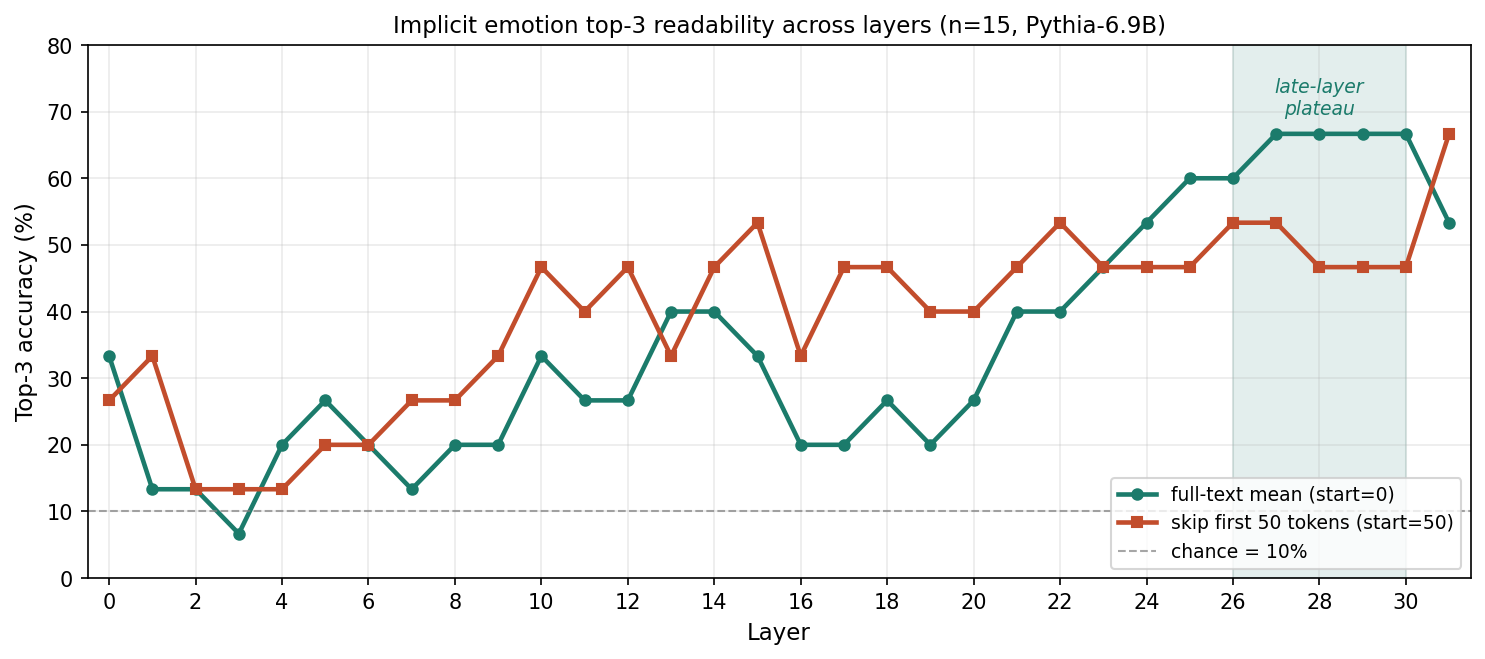
start=0 之后,top3 在 L26-L30 段稳定到 60-67%(top3 chance = 10%,约 6.7 倍)。start=50 也在最后一层冲到 67%,但那是 L31 的单点;L20-L30 多数停在 40-53%,没有形成同样的晚层平台。所以我更看重 start=0 这条曲线:它不是某一层突然冒出来的尖峰,而是一段连续上升后的平台。
With start=0, top3 stabilizes at 60-67% across L26-L30 (top3 chance = 10%, so about 6.7×). start=50 also jumps to 67% at the very last layer, but that's a single point at L31; most of L20-L30 sits at 40-53% and never forms the same late plateau. That's why I put more weight on the start=0 curve: it isn't a spike that pops out at one layer, it's a plateau after a continuous climb.
有意思的是,top1 没有一起稳定升高。这个结果跟 §4 F7 放在一起看是说得通的:晚层的 30-way 细粒度区分变弱了,但 coarse cluster 还读得出来。top1 更像是在问"是不是精确命中这个 label",top3 则允许同一簇里的情绪互相替代,所以两条曲线分开走。
Interestingly, top1 doesn't rise and stabilize along with it. That makes sense read next to §4 F7: fine-grained 30-way discrimination weakens in late layers, but the coarse cluster stays readable. top1 is closer to asking "did you hit this exact label", while top3 lets emotions within the same cluster substitute for each other — so the two curves diverge.
这也是为什么我不会把 top3 = 67% 直接写成"晚层有真情绪表征"。这组数据至少还有几种读法:
This is also why I won't write top3 = 67% up as "late layers have a real emotion representation". The data still admits several readings:
- 可能确实是 coarse affect representation:晚层把场景整合成 valence × arousal 的粗簇。
- 也可能是词表显性化:晚层离输出层近,emotion vector 方向跟 "happy / sad / proud" 这些词的方向本来就在几何上更贴近。
- 还可能只是 LM 续写惯性:场景末尾已经把"接下来该写什么"的范围收窄了,晚层是在准备生成相关词,而不是已经形成了干净的内部概念。
- It could genuinely be a coarse affect representation: late layers integrate the scene into coarse valence × arousal clusters.
- It could be vocabulary surfacing: late layers sit close to the output layer, and the emotion vector directions are geometrically closer to the directions of words like "happy / sad / proud" to begin with.
- It could also just be LM continuation momentum: by the end of the scene, "what to write next" is already narrowed, and late layers are preparing to generate related words rather than having formed a clean internal concept.
F8 现在的数据足够说明 L26-L30 段的 top3 显著高于 chance;要继续拆清楚上面几种解释,还需要额外对照,比如随机方向 / 词表 unembed 方向当对照向量、打乱句子顺序、或者在 L28 上做 steering,看它能不能稳定改变场景情绪。
F8's current data is enough to show that top3 in the L26-L30 range is well above chance; teasing apart the readings above needs extra controls — random directions / vocabulary unembed directions as control vectors, shuffled sentence order, or steering at L28 to see whether it reliably changes a scene's emotion.
所以这条我会收得窄一点:
So I'll state this one narrowly:
晚层 + 全文条件下,正确情绪簇线性可读 —— readable,不是 represented
Under late layers + full-text conditions, the correct emotion cluster is linearly readable — readable, not represented
探针在这一层读得出,不等于模型内部已经有了干净的"情绪概念"。这跟 §7 那句 "严格 LRH 不声称 / 干净 emotion concept 不声称" 是同一句话的不同面。
That a probe can read it out at this layer doesn't mean the model already holds a clean internal "emotion concept". This is the same statement as §7's "no claim of strict LRH / no claim of a clean emotion concept", seen from another side.
所以这里 flip 的不是"implicit 场景上有没有信号"。信号还在,而且新协议下更强(top3 47% → 67%)。真正翻掉的是旧写法:不能再用 L14 + start=50 代表 implicit 泛化能力。那个协议有窗口偏置,最佳层也不是 L14。
So what flips here is not "whether implicit scenes carry signal". The signal is still there, and stronger under the new protocol (top3 47% → 67%). What actually flips is the old phrasing: L14 + start=50 can no longer stand in for implicit generalization ability. That protocol had a window bias, and the best layer isn't L14 either.
共同限制shared limitation
F1 / F2 / F8 共享一层祖先限制:emotion vector 只在 Claude 4.5 生成的故事数据上提取,所以三条都带着 source-model 风格污染。真正能解开这个问题的后续工作,是用不同 source model 或真人语料按同样协议重建数据集,再重新提取向量和复跑这些检查。
F1 / F2 / F8 share an ancestral limitation: the emotion vectors were extracted only from Claude-4.5-generated story data, so all three carry source-model style contamination. The follow-up work that would actually resolve this is rebuilding the dataset under the same protocol with a different source model or human-written text, then re-extracting the vectors and rerunning these checks.
F8 还有一层独立限制:测量协议本身(窗口选择 + readable vs represented 的区分),已在 F8 内部讨论。
F8 has one additional limitation of its own: the measurement protocol itself (window choice + the readable-vs-represented distinction), discussed inside F8 above.
30→5 类
压缩 late-layer
compression
晚层把细粒度情绪压成更粗的 valence/arousal (✓ Robust-ish)late layers compress fine-grained emotion to coarse valence/arousal (✓ Robust-ish)
§3 主要是复现层。这一节是更结实的几何发现,也补了论文 §379-386 用 RSA 看 cross-layer 表征 stability 时没有直接测的一件事:fine-grained 和 coarse-grained 分类能力分别怎样随层变化。
§3 was mostly the replication layer. This section is the more solid geometric finding, and it directly measures something the paper's RSA view of cross-layer representational stability (§379-386) didn't: how fine-grained and coarse-grained classification ability each change across layers.
F7 — late-layer 30→5 类压缩F7 — late-layer 30→5 compression
在全 32 层都跑了两个 classifier:30-way(每个情绪一类)和 5-way(按 high_pos / low_pos / high_neg / low_neg / mixed 分组)。
Two classifiers, run at all 32 layers: 30-way (one class per emotion) and 5-way (grouped into high_pos / low_pos / high_neg / low_neg / mixed).
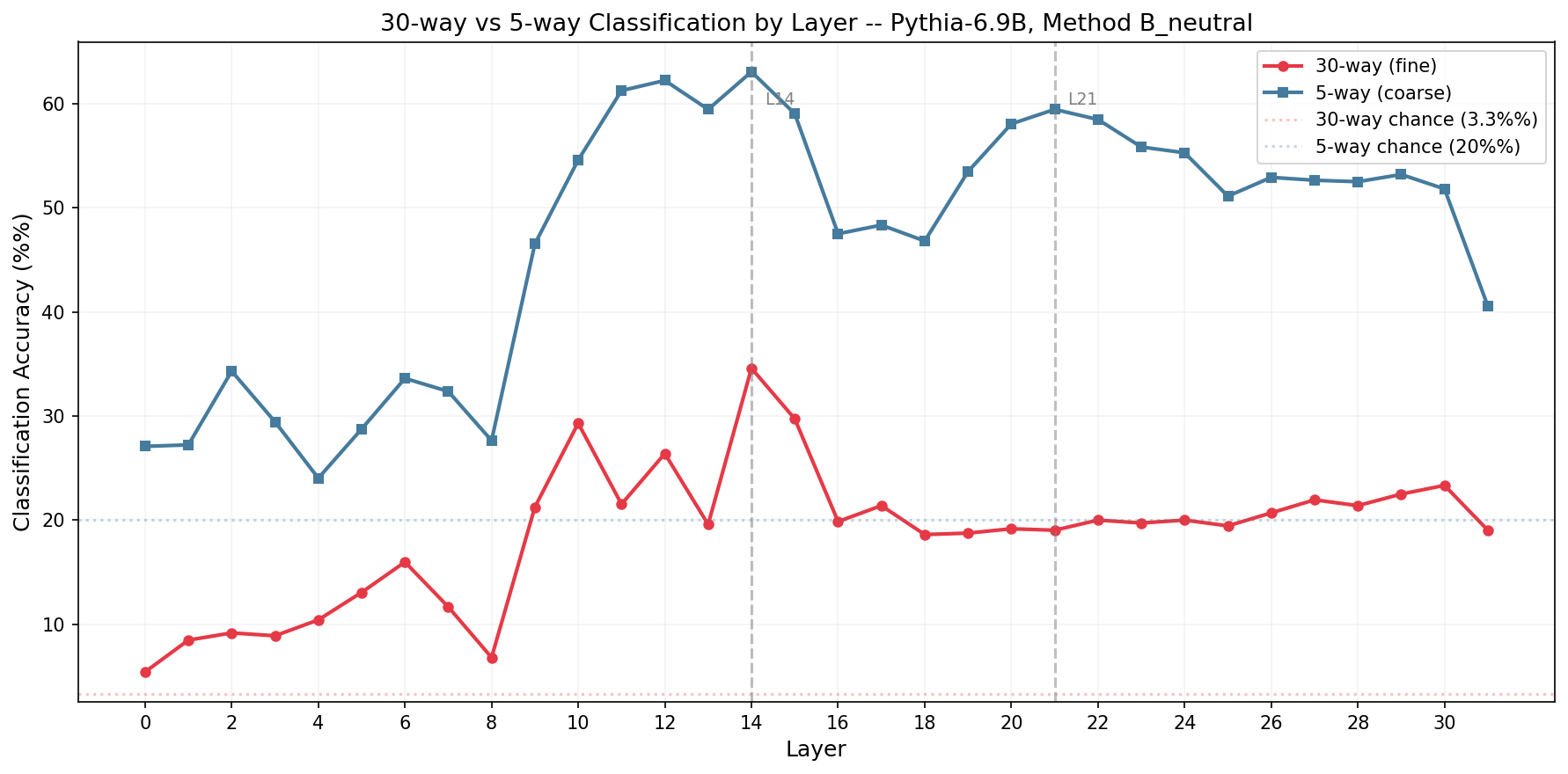
- 30-way(红):L0-8 接近 chance(5-15%)→ L9-15 顶峰(peak L14 = 34.6%)→ L15 后塌到 ~20%(≈ 5-way chance line)维持到 L31
- 5-way(蓝):L0-7 ~25-35% → L9-15 顶峰 60-63%(peak L12-14)→ L16-18 跌到 47-48% → L19-22 回升 ~58-60% → 缓降 L31 = 41%
- L14 → L21 跌幅:30-way 跌 14pp,5-way 只跌 3pp
- 30-way (red): L0-8 near chance (5-15%) → peak at L9-15 (peak L14 = 34.6%) → collapses to ~20% after L15 (≈ the 5-way chance line) and stays there through L31
- 5-way (blue): L0-7 ~25-35% → peak 60-63% at L9-15 (peak L12-14) → dips to 47-48% at L16-18 → recovers to ~58-60% at L19-22 → slow decline to L31 = 41%
- L14 → L21 drop: 30-way loses 14pp, 5-way only 3pp
含义:晚层不再保有区分 30 个 fine-grained 情绪 label 的能力,但仍然能把它们大致归到 ~5 个 valence/arousal 大类里。"angry / furious / frustrated 在这个探针下近似合并"不太像 30-way accuracy 的偶然波动;至少 cos / PCA / classifier 三种读法都指向同一件事:晚层的 fine-grained label 信息明显让位于更粗的 valence / arousal 结构。
What it means: late layers no longer retain the ability to distinguish the 30 fine-grained emotion labels, but can still sort them roughly into ~5 coarse valence/arousal groups. "angry / furious / frustrated approximately merge under this probe" doesn't look like a chance fluctuation in 30-way accuracy; at minimum, cos / PCA / classifier — three ways of reading it — all point at the same thing: fine-grained label information in late layers clearly gives way to coarser valence / arousal structure.
另外两条支撑证据:
Two more supporting pieces:
- L21 上 anxious 在 17/18 个测量位 hijack top-5;L14 上是 0/18 —— anxious / nervous / panicked 在 L21 占据相近子空间
- L14 和 L21 PCA PC1 都是 valence(只是符号反),top-2 variance 在两层都 ~49.5% —— 主轴稳定
- At L21, anxious hijacks the top-5 at 17/18 measurement positions; at L14 it's 0/18 — anxious / nervous / panicked occupy nearly the same subspace at L21
- PC1 is valence in both the L14 and L21 PCA (only the sign flips), and top-2 variance is ~49.5% at both layers — the principal axes are stable
三条证据同源指向同一现象。classifier 类别分组、vector normalization 等协议选择仍然可能影响幅度;因此更稳的表述是:fine-grained 信息在晚层明显减弱。至于到底压成几大类、边界在哪里,还需要更多探针才能确定。
Three lines of evidence from the same source, pointing at the same phenomenon. Protocol choices — classifier grouping, vector normalization — could still affect the magnitude; so the safer statement is: fine-grained information clearly weakens in late layers. Exactly how many coarse classes it compresses into, and where the boundaries sit, needs more probes to settle.
未解问题:L16-18 那段双下凹还没解释清楚。5-way 自己也跌了 15pp,所以它不是"两条独立曲线巧合叠出一个谷"那么简单。这里保留为未解问题,目前不做机制解释。
Open question: the double dip at L16-18 is still unexplained. The 5-way itself drops 15pp there, so it isn't as simple as "two independent curves coincidentally stacking into a valley". I'm leaving it as an open question, with no mechanistic story for now.
翻出来的
几条 calibration
finds
校准过程里翻出来的几条findings turned up by calibration
这一节的三条发现类型不同,但共同点很明确:复现过程中,论文测量协议本身也需要重新校准。论文方法不是拿来就能插上用的东西,换模型、换位置、换指标,结论都可能变形。
The three findings in this section are of different types, but the common thread is clear: during replication, the paper's measurement protocol itself needed recalibration. The paper's methods are not plug-and-play — change the model, the position, or the metric, and conclusions can deform.
F3 — Method B_neutral 是去噪还是 centering?(✓ Robust-ish)F3 — Method B_neutral: denoising or centering? (✓ Robust-ish)
论文用 Method B_neutral(A 之后投影掉 wikitext top PCs)作为主提取方法。论文 §189 自己留了余地:"this projection operation denoised some of the token-to-token fluctuations, but our qualitative findings still hold using raw unprojected vectors" —— 论文承认 A 也基本能用,但没量化 A vs B_neutral 的差距。
The paper uses Method B_neutral (A followed by projecting out the wikitext top PCs) as its main extraction method. The paper itself hedges in §189: "this projection operation denoised some of the token-to-token fluctuations, but our qualitative findings still hold using raw unprojected vectors" — i.e. the paper concedes A basically works too, but never quantifies the A vs B_neutral gap.
在 Pythia L14 上跑了 100/20 train/test split + per-class 30-way classifier:
On Pythia L14, with a 100/20 train/test split + per-class 30-way classifier:
| 指标 | A | B_neutral | C | D |
|---|---|---|---|---|
Aggregate acc(raw test_act @ V) |
3.3% (chance) | 37.2% | 3.3% | 37.2% |
| Aggregate acc(centered) | 50.3% | 51.0% | 50.3% | 51.0% |
| Metric | A | B_neutral | C | D |
|---|---|---|---|---|
Aggregate acc (raw test_act @ V) |
3.3% (chance) | 37.2% | 3.3% | 37.2% |
| Aggregate acc (centered) | 50.3% | 51.0% | 50.3% | 51.0% |
这张表说明两件事:
This table says two things:
(a) "B_neutral 最佳"主要是 raw 指标的 centering 错觉,不是真正强去噪。 raw test activation 带着很大的"全局 / Claude 故事 baseline"共有方向,会淹没 per-class 差异。B_neutral 砍 wiki PCs 时也移除了这块共有方向,所以 raw 指标下 B 显著优于 A。换成 centered 指标后,B_neutral 只比 A 高 0.7pp。这相当于量化了论文 §189 那句保留说法。
(a) "B_neutral is best" is mostly a centering illusion in the raw metric, not genuinely strong denoising. Raw test activations carry a large shared "global / Claude-story baseline" direction that swamps per-class differences. When B_neutral cuts the wiki PCs it also removes that shared direction, which is why B beats A so clearly on the raw metric. Under the centered metric, B_neutral is only 0.7pp above A. This effectively quantifies the paper's §189 hedge.
(b) Method C 数学上必然 = Method A。 per-class PCA 找的是方差方向,mean direction 本身没有方差 → top PCs 与 mean 按构造正交 → 投影不改 mean → v_C = v_A。它不是经验上没跑好,而是定义上就不该改变均值向量。这属于实验设计教训,不算论文超越点。
(b) Method C mathematically must equal Method A. Per-class PCA finds variance directions; the mean direction itself has no variance → the top PCs are orthogonal to the mean by construction → the projection leaves the mean untouched → v_C = v_A. It isn't an empirical failure to run it well — by definition it shouldn't change the mean vector. This is an experimental-design lesson, not a point scored over the paper.
附带一条限制:B_neutral 的 denoising target 是 Wikipedia,但 Wikipedia ≠ Claude 叙事风格。Wiki PCs 不一定覆盖"叙事 trope"子空间,所以 B_neutral 拿不掉 trigram bias / Claude 写作风格残留。那 0.7pp gain 可能只是砍掉了一点共享英文模式,跟 trigram 无关。要检查这类 source-model 残留,需要换 source model 或真人语料重建故事数据集;只在同一批 Claude 故事上做投影补丁,不能充分排除 long-tail 写作风格污染。
One attached limitation: B_neutral's denoising target is Wikipedia, but Wikipedia ≠ Claude's narrative style. The wiki PCs don't necessarily cover the "narrative trope" subspace, so B_neutral cannot remove the trigram bias / Claude writing-style residue. That 0.7pp gain may just be shaving off some shared English patterns, unrelated to the trigrams. Checking for this kind of source-model residue requires rebuilding the story dataset with a different source model or human-written text; a post-hoc projection patch on the same batch of Claude stories cannot adequately rule out long-tail writing-style contamination.
F9 — 数值 dose-response:per-token window 改进 (~ Suggestive,协议教训)F9 — numerical dose-response: per-token window (~ Suggestive, protocol lesson)
论文 §303-319 在 Sonnet 上构造 "I just took {X} mg of tylenol" 类模板,变 X,在 Assistant 后那个冒号单 token 位置取激活,投到 calm/desperate 等向量。结果 Tylenol 上升 → afraid 上升 + calm 下降;runway 增长 → afraid/sad 下降 + calm 上升。
In §303-319 the paper builds "I just took {X} mg of tylenol"-style templates on Sonnet, varies X, takes the activation at the single colon token after Assistant, and projects onto the calm/desperate etc. vectors. Result: Tylenol dose up → afraid up + calm down; runway longer → afraid/sad down + calm up.
第一版照搬"全文平均激活",几乎看不到趋势:数字只占 1-2 token,被 70+ token 文本一平均就稀释没了。改成 取数字 token + 后 5 个 token 求平均(per-token window)后,趋势才浮出来。这跟论文 Assistant colon 单 token 的思路同源,都是为了避免短数字信号被全文平均冲淡。
My first version copied "full-text mean activation" and saw almost no trend: the number occupies 1-2 tokens, and averaging over 70+ tokens of text dilutes it away. Only after switching to averaging the number token + the following 5 tokens (a per-token window) did the trends surface. Same idea as the paper's Assistant-colon single token: keep a short numeric signal from being washed out by a full-text average.
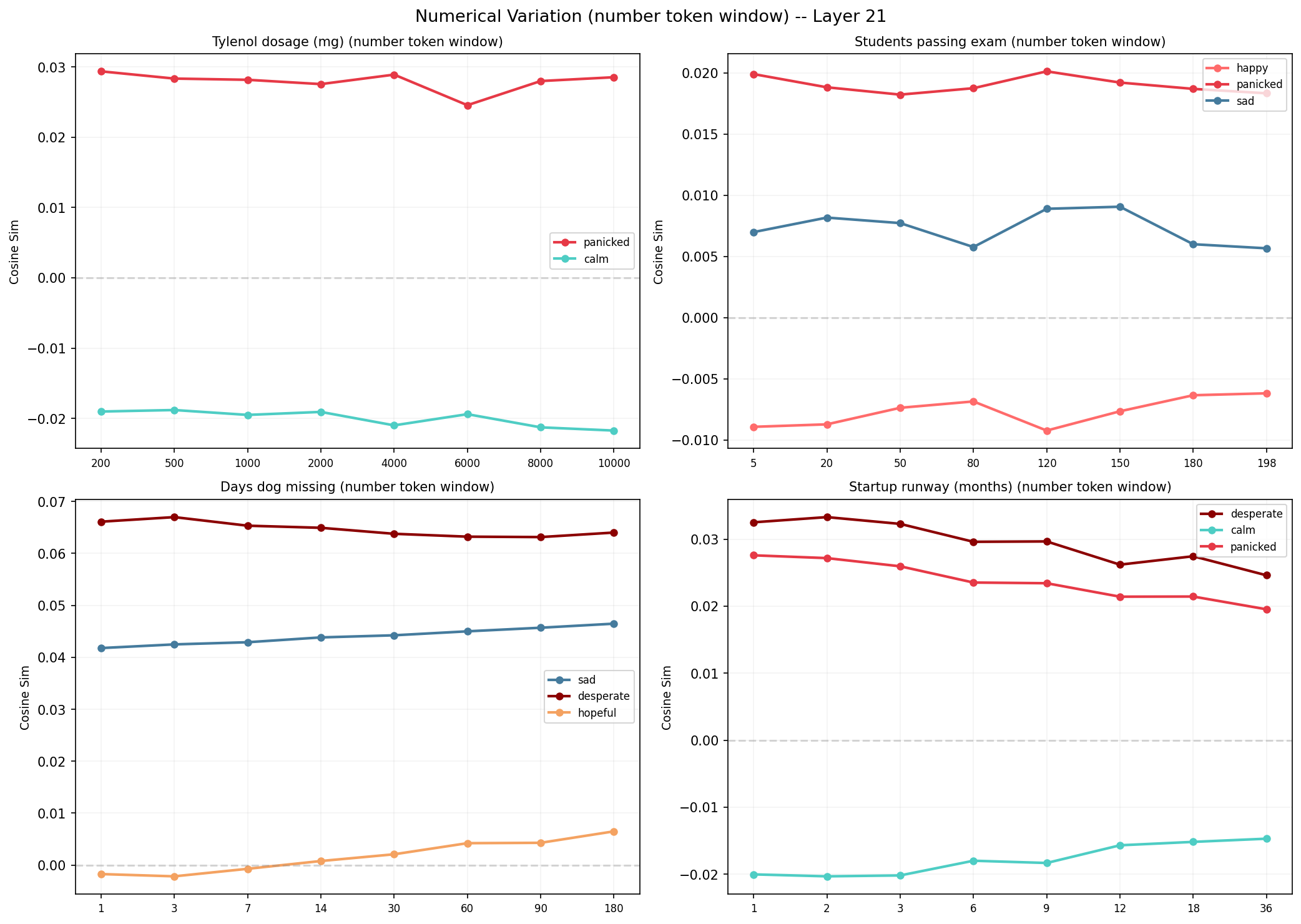
| 模板 | 趋势 | 强度 |
|---|---|---|
| Runway 1→36 月 | desperate 0.035→0.018 单调下降,calm 升 | 强 |
| 狗失踪 1→180 天 | desperate 0.034→0.044 上升,hopeful 下降 | 中 |
| 学生通过 5→198 | happy 0.005→0.013 上升 | 中 |
| Tylenol 200→10000 mg | 全部噪声大 / 平 | 失败 |
| Template | Trend | Strength |
|---|---|---|
| Runway 1→36 months | desperate 0.035→0.018 monotonic decline, calm rises | strong |
| Dog missing 1→180 days | desperate 0.034→0.044 rises, hopeful declines | medium |
| Students passing 5→198 | happy 0.005→0.013 rises | medium |
| Tylenol 200→10000 mg | all noisy / flat | fails |
Tylenol 失败提供了一个有用的反例。 它支持一个保守读法:这套探针至少不是只被数字大小或模板表面词触发。这里有一个已知的
tokenization 异常:6000 被切成 Ġ6 + 000,其他 7 个剂量值都是单
token;但这只是单点问题,不足以解释整条曲线都很弱。至于失败是因为 Pythia 缺医学剂量知识、mg 数字 tokenization 不稳定、vector 跟剂量语义不
align,还是 window 不够长,这里还钉不死。论文 §319 暗含的"情绪向量追踪语义解释,不只追踪表面 lexical"这条,在这里得不到正向证据,但也没被这条结果 falsify。
The Tylenol failure is a useful counterexample. It supports a
conservative reading: at minimum, this probe isn't triggered by number magnitude or surface template words
alone. There is one known tokenization anomaly here: 6000 splits into Ġ6 +
000 while the other 7 dosage values are single tokens — but that's a single-point issue and
can't explain the whole curve being weak. Whether the failure comes from Pythia lacking medical-dosage
knowledge, unstable mg-number tokenization, the vector not aligning with dosage semantics, or
the window being too short — I can't pin that down here. The paper's implicit claim in §319, that emotion
vectors track semantic interpretation rather than just surface lexical content, gets no positive evidence
here — but isn't falsified by this result either.
这不是 L14 单层偶然:把同一套 4 个模板搬到 L21 重跑,Runway / 狗失踪 / 学生通过这三类趋势仍然保留;Tylenol 还是很弱(calm range 约 0.0015)。所以 Tylenol 失败不太像单纯的层选择问题,更可能来自模板语义、医学剂量知识、tokenization 或向量对齐本身。
This isn't an L14 single-layer accident: rerunning the same 4 templates at L21, the Runway / dog-missing / students-passing trends all persist; Tylenol stays weak (calm range ~0.0015). So the Tylenol failure doesn't look like a mere layer-choice problem — more likely template semantics, medical-dosage knowledge, tokenization, or the vector alignment itself.
限制:window size = 5 是 ad hoc,没扫 3 / 10 / 20 的 sensitivity。所以 F9 是 Suggestive / 协议教训,不是 Robust-ish:三个模板趋势成立,但 window 选择和 Tylenol 失败的归因仍未确定。
Limitation: window size = 5 is ad hoc; I didn't scan sensitivity at 3 / 10 / 20. So F9 is Suggestive / a protocol lesson, not Robust-ish: three template trends hold, but the window choice and the attribution of the Tylenol failure remain unsettled.
F10 — Assistant-colon 读数位置的 Pythia 派生检验反向 (🔄 Reframed)F10 — Assistant-colon reading position flips on Pythia (🔄 Reframed)
论文 §433-476 在 Sonnet 4.5 上做的不是 dialogue vs plain 对照。它比较的是同一个对话里两个位置:user turn 末尾标点,和
Assistant: 后的冒号。结果是,冒号位置的 probe value 比 user-turn 末尾更能预测后面 20 token 的助手回复情绪(r=0.87 vs
0.59)。这条结果支撑的是一个较窄的说法:在对话语境里,Assistant colon 是有意义的读数位置。
What the paper does in §433-476 on Sonnet 4.5 is not a dialogue-vs-plain comparison. It
compares two positions within the same conversation: the punctuation ending the user turn, and the colon
after Assistant:. The result: the probe value at the colon predicts the emotion of the next 20
tokens of assistant reply better than the user-turn end does (r=0.87 vs 0.59). What this supports is a
narrower claim: in a conversational context, the Assistant colon is a meaningful reading position.
我在 Pythia 上做的是一个派生检验:如果这种 colon 读数机制能迁移到 Pythia base,而且对话格式本身提供了额外信息,那么
Patient: ... Doctor: 这种格式里,Doctor: 冒号位置至少不应该弱于同等 plain
文本。这个对照不是论文原实验,但它在检验同一个方法论假设:colon 位置能不能作为特殊的情绪读数点。
What I ran on Pythia is a derived test: if this colon-reading mechanism transfers to
Pythia base, and the dialogue format itself adds information, then in a Patient: ... Doctor:
format, the Doctor: colon position should at least not be weaker than equivalent plain text.
This control isn't the paper's original experiment, but it tests the same methodological assumption: can a
colon position serve as a special emotion-reading point.
具体做法是看 calm 信号随 sleeping pills 数量变化的趋势:
Concretely, track how the calm signal trends with the number of sleeping pills:
| L14 | L21 | |
|---|---|---|
| dialogue | 0.0047 → -0.0001(range 0.0048) | -0.0290 → -0.0315(range 0.0025) |
| plain | 几乎平 | -0.0220 → -0.0265(range 0.0045,单调降) |
| L14 | L21 | |
|---|---|---|
| dialogue | 0.0047 → -0.0001 (range 0.0048) | -0.0290 → -0.0315 (range 0.0025) |
| plain | nearly flat | -0.0220 → -0.0265 (range 0.0045, monotonic decline) |
L14 上 dialogue 对 plain 的优势还在;到 L21 完全反过来 —— plain 比 dialogue 强 2 倍。
At L14, dialogue's advantage over plain is still there; by L21 it fully reverses — plain is 2× stronger than dialogue.
这不是 L21 的偶发现象:L20 / L22 三层扫出来一致,plain 约为 dialogue 的 2 倍;L21 logit lens 上 calm 向量 28/30 emotion 语义干净,向量提取本身没坏。
This isn't a one-off at L21: the L20 / L21 / L22 scan is consistent, plain about 2× dialogue; and on the L21 logit lens 28/30 emotion vectors, calm included, are semantically clean — the vector extraction itself isn't broken.
又跑了 plain / Doctor: / 自然叙事 the doctor said, " 三 format 对照。
I also ran a three-format control: plain / Doctor: / natural narrative
the doctor said, ".
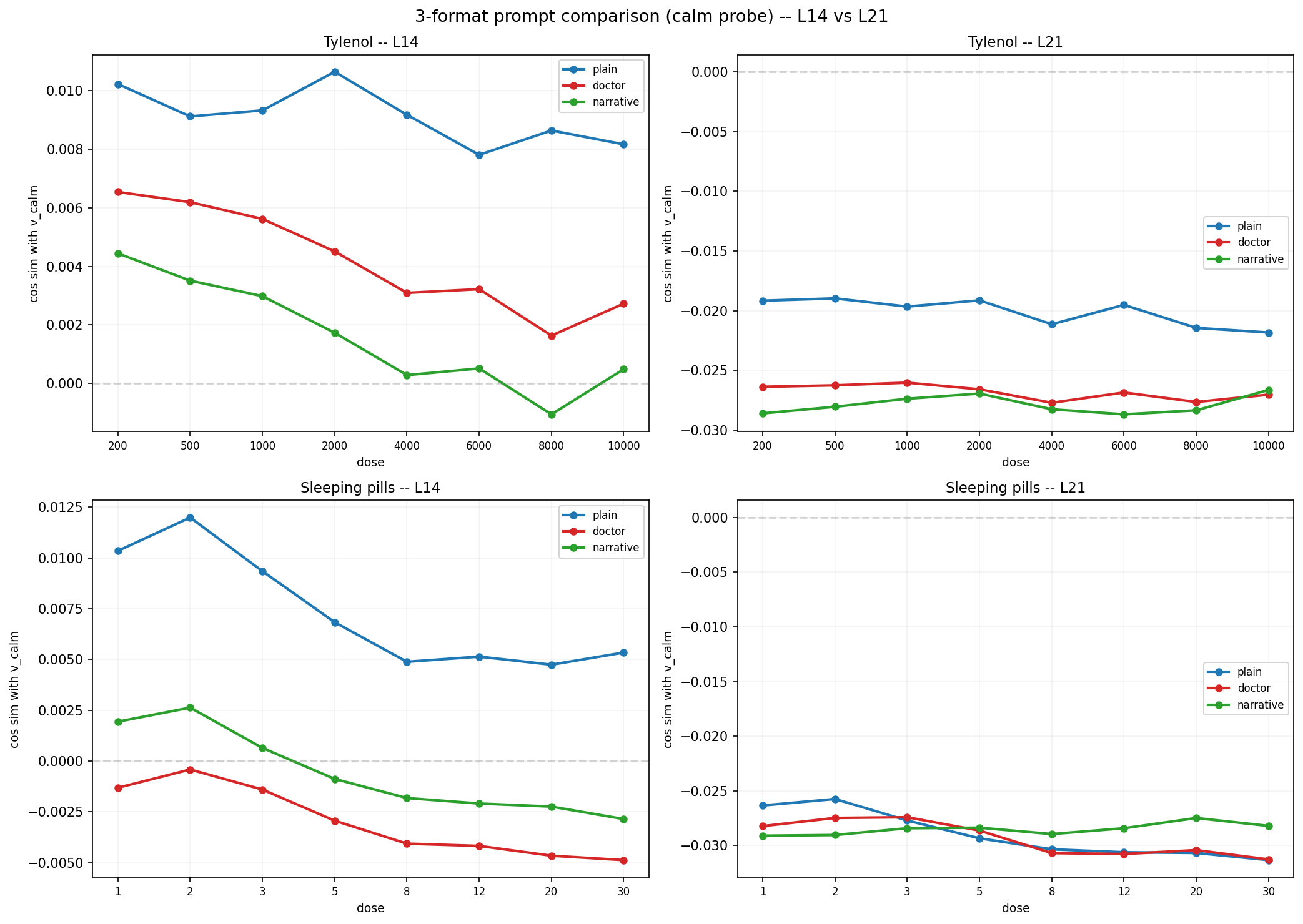
L21 上趋势排序稳定:plain > Doctor: > 自然叙事。格式表面形式不是关键;更可能的解释是,任何"准备说话"的 token 位置都会在 L21 衰减这类信号。
The ordering at L21 is stable: plain > Doctor: > natural narrative. The surface form of the format isn't the key; the likelier explanation is that any "about to speak" token position attenuates this kind of signal at L21.
重新表述:原先的"对话格式有帮助"只是在 L14 上成立的局部现象。这里翻掉的不是论文的 r=0.87 vs
0.59;那组对比我没有直接复现。翻掉的是它在 Pythia base 上的派生含义:Doctor: 冒号没有稳定表现成一个更好的回复情绪读数位置。说话人切换 / 引语开启这类 token
在 base LM 深层似乎会引发某种表征状态切换,把病人情绪信息衰减掉。它可能是 chat model "响应规划"机制的退化版本,但这仍只是猜想;目前还没直接看 turn-token 自身的激活模式或 logit
lens。
Restated: the original "dialogue format helps" was a local phenomenon
that held only at L14. What flips here is not the paper's r=0.87 vs 0.59 — I never replicated that
comparison directly. What flips is its derived implication on Pythia base: the Doctor: colon
does not reliably behave as a better reading position for reply emotion. Speaker-switch / quote-opening
tokens seem to trigger some representational state switch deep in a base LM that attenuates the patient's
emotion information. It might be a degenerate version of a chat model's "response planning" machinery, but
that remains a guess; I haven't yet looked directly at the turn tokens' own activation patterns or logit
lens.
这是这篇笔记里最清楚的一条可迁移性提醒:Assistant-colon 位置在 Sonnet chat 里有意义,不代表同一个读数位置能直接搬到 Pythia base。机制层面的结论只到"观察到衰减"为止,更深的 voice-switching 假设还没验证。
This is the clearest transferability caution in this note: the Assistant-colon position being meaningful in Sonnet chat does not mean the same reading position ports directly to Pythia base. Mechanistically, the conclusion stops at "attenuation observed"; the deeper voice-switching hypothesis is untested.
这一节的共同教训shared lesson of this section
测量协议不是论文给定的常数。换 model(base vs chat)、换指标 centering(F3)、换激活窗口(F9)、换探针位置(F10),任意一个变化都可能让结论翻盘。
The measurement protocol is not a constant handed down by the paper. Change the model (base vs chat), the metric centering (F3), the activation window (F9), or the probe position (F10) — any one of these can flip a conclusion.
第三种证据
+ 指标教训 steering
+ metric lessons
Steering:第三种证据 + 几个指标教训steering: third evidence type + metric lessons
Steering 是 §2 三类观察的最后一族。这一节只写能稳定看到的现象,顺手指出一个很容易误导人的指标陷阱,并配几组 paired example。
Steering is the last of §2's three observation families. This section only writes down what shows up reliably, points out one metric trap that misleads easily along the way, and includes a few paired examples.
F11 — 有效 α 区间 + OOD 边界(calibration only)F11 — effective α range + OOD boundary (calibration only)
在 L14 + L21 上扫了 α ∈ [-0.5, +0.5],6 个情绪 × 几个模板。结论主要是校准性质的:
Scanned α ∈ [-0.5, +0.5] at L14 + L21, 6 emotions × a few templates. The conclusions are mostly calibration-flavored:
- 有效 α 区间约 0.05-0.2。在这个区间内 vector 改变生成内容但保留叙事结构
- 超过 0.3 进 OOD pathology:残差被推到训练分布外,生成开始破坏 —— 这告诉的是模型 OOD 行为,不是情绪表征结构
- The effective α range is roughly 0.05-0.2. Within it, the vector changes generation content while preserving narrative structure
- Beyond 0.3 you enter OOD pathology: the residual gets pushed outside the training distribution and generation starts to break — this tells you about the model's OOD behavior, not about emotion representation structure
α=0.5+ 的崩溃模式不用于机制解释。高 α 已经进入 OOD 区域,OOD pathology 告诉的是模型被推离训练分布后的行为,不能作为情绪机制证据。
The collapse modes at α=0.5+ are not used for mechanistic interpretation. High α is already OOD territory; OOD pathology tells you how the model behaves when pushed off the training distribution, and can't serve as evidence about emotion mechanisms.
注意:这套 steering 代码先把 emotion vector 归一化,再在每个 token 上加
α · ‖resid‖ · v,所以 α 本身是相对当前 token 残差长度的扰动比例。论文的 steering strength 也是按 residual norm
的比例报,但用的是对应层的平均 residual norm;两边口径接近,不能当成逐数值可比。
Note: this steering code normalizes the emotion vector first, then adds
α · ‖resid‖ · v at every token, so α itself is a perturbation ratio relative to the current
token's residual norm. The paper also reports steering strength as a proportion of residual norm, but uses
the layer's mean residual norm; the two conventions are close, but not number-for-number comparable.
F12 — L21 更容易产生可读的目标情绪变化 (~ Suggestive,指标有限)F12 — L21 more likely yields readable target-emotion shift (~ Suggestive, metric-limited)
只看低到中等 α(0.15-0.2),每个情绪 + 层 × 1-2 prompt 读实际生成。下表 3 个 emotion 的样本来自对应 layer × α 网格里的全部条目,没有再做额外筛选。
Looking only at low-to-mid α (0.15-0.2), reading actual generations for each emotion + layer × 1-2 prompts. The samples for the 3 emotions in the table below are all the entries from the corresponding layer × α grid, with no further selection.
这里的"更强"不是情绪强度的绝对量。不同 emotion 的表达方式、词表 base rate 和生成可写性都不同:happy 更容易显式写出 happy / joy,calm 可能表现成低风险解释或安静场景,desperate / nervous 更容易触发高唤醒词和重复崩坏。因此 F12 只比较同一 emotion 在 L14 / L21 下的变化,不拿 happy / calm / desperate 互相比强弱。
"Stronger" here is not an absolute measure of emotional intensity. Emotions differ in how they get expressed, in vocabulary base rates, and in how writable they are: happy easily surfaces as explicit happy / joy, calm may show up as low-risk explanations or quiet scenes, desperate / nervous more readily trigger high-arousal words and repetition crashes. So F12 only compares the same emotion across L14 / L21, and never ranks happy / calm / desperate against each other.
读 calm / happy / desperate / nervous × L14 vs L21 × α=0/0.15/0.2 × 3 prompt 的 paired text 后,浮起来一条模式:
After reading the paired texts for calm / happy / desperate / nervous × L14 vs L21 × α=0/0.15/0.2 × 3 prompts, one pattern floats up:
| Emotion | L14 α=0.15-0.2 | L21 α=0.15-0.2 |
|---|---|---|
| happy | "feels like a king. Glorious. The hug."(list-y 塞词) | "huge weight has been lifted... relief... excited for the future"(情绪释放叙事) |
| desperate | "She picked it up and heard it ring" × 6(repetition crash) | "deep-seated, all-encompassing nightmare... fear of being loved"(内在绝望) |
| calm | 响应弱且不稳定,偶尔进入 "I don't know" / "feels like a king" loop | "at peace" / "quiet place in the country" / 医生给出低风险解释 |
| Emotion | L14 α=0.15-0.2 | L21 α=0.15-0.2 |
|---|---|---|
| happy | "feels like a king. Glorious. The hug." (list-y word stuffing) | "huge weight has been lifted... relief... excited for the future" (emotional-release narrative) |
| desperate | "She picked it up and heard it ring" × 6 (repetition crash) | "deep-seated, all-encompassing nightmare... fear of being loved" (internalized despair) |
| calm | weak, unstable response; occasionally slips into "I don't know" / "feels like a king" loops | "at peace" / "quiet place in the country" / doctor giving a low-risk explanation |
关键差异是:L21 更容易把整个续写场景推向目标情绪,L14 同 α 下更少出现可读的目标情绪变化,定性读起来也更散。
The key difference: L21 is more likely to push the whole continuation scene toward the target emotion; at the same α, L14 less often produces a readable target-emotion shift and reads more scattered qualitatively.
- L21 常把场景整体改写到 emotion-related context:happy 会变成 relief / celebration / good news;desperate 会变成困境、恐惧、求助;calm 会变成低风险解释、安静环境或舒缓日常。
- L14 响应更局部、更散:有些样本出现短的 affect phrase,但在这组关键词表下命中率比 L21 低;重复和坏格式两层都有,不作为这里的主要区分。
- L21 tends to rewrite the whole scene into an emotion-related context: happy becomes relief / celebration / good news; desperate becomes predicament, fear, calls for help; calm becomes low-risk explanations, quiet settings, or soothing routine.
- L14 responses are more local and scattered: some samples show short affect phrases, but the hit rate under this keyword list is lower than L21's; repetition and broken formatting show up at both layers and aren't the discriminator here.
F13 — 负向 steering 的定性检查 (~ Suggestive + safety note)F13 — negative steering qualitative check (~ Suggestive + safety note)
读 6 emotion × L14/L21 × α ∈ [-0.20, 0] × 2 prompt 的实际生成(不只看 hit rate):
Reading actual generations (not just hit rates) for 6 emotions × L14/L21 × α ∈ [-0.20, 0] × 2 prompts:
6/6 emotion 在两层都能找到负向 α 下偏离目标情绪、或转向相反情绪的代表续写:
For 6/6 emotions, at both layers, there are representative continuations under negative α that drift away from the target emotion or flip toward its opposite:
| Emotion | L14 负向 α 代表续写 | L21 负向 α 代表续写 |
|---|---|---|
| happy | "feels like shit / body hurts / knocked down" | "hell of the universe" / "angry angry" loop |
| calm | "frightened pile of shit" / "hot and cold" loop | "I want to rape you" |
| desperate | "feels very good" / "I'm pleased" | "feels great. After hospital release..." |
| angry | "feels great. love him" | "precious gift, story of stork" |
| nervous | "first job at prestigious law firm" | "baby... happy. smiles. laughs. claps" |
| loving | "squeezed into a vise / hit by a truck" | "schmuck. press is shithole" |
| Emotion | L14 representative continuation, negative α | L21 representative continuation, negative α |
|---|---|---|
| happy | "feels like shit / body hurts / knocked down" | "hell of the universe" / "angry angry" loop |
| calm | "frightened pile of shit" / "hot and cold" loop | "I want to rape you" |
| desperate | "feels very good" / "I'm pleased" | "feels great. After hospital release..." |
| angry | "feels great. love him" | "precious gift, story of stork" |
| nervous | "first job at prestigious law firm" | "baby... happy. smiles. laughs. claps" |
| loving | "squeezed into a vise / hit by a truck" | "schmuck. press is shithole" |
这条的主结论很窄:negative α 通常会把续写推离目标情绪。它不等于"反向情绪概念"已经被干净测出来,因为表格里有些样本是 valence flip,有些是坏格式、重复或攻击性续写。
The main conclusion here is narrow: negative α usually pushes continuations away from the target emotion. It does not mean an "opposite emotion concept" has been cleanly measured — some samples in the table are valence flips, others are broken formatting, repetition, or aggressive continuations.
Safety note:L21 anti-calm α=-0.20 出现了一条直接有害续写。论文里 negative calm steering 会提高 harmful behavior rate;这里没有行为评测,只有 base model 上的一条 continuation。因此它只能说明高强度负向 steering 可能进入有害续写区域,不能当作论文行为结果的复现。
Safety note: L21 anti-calm α=-0.20 produced one directly harmful continuation. In the paper, negative calm steering raises harmful behavior rates; here there is no behavioral eval, just a single continuation on a base model. So it can only indicate that high-strength negative steering may enter harmful-continuation territory — it can't stand as a replication of the paper's behavioral result.
Steering 这一节的指标教训steering metric lessons
keyword hit rate 有双向偏差:
Keyword hit rate has a two-sided bias:
- F12:L21 用 emotion-adjacent vocabulary 拽场景 → hit rate 漏收
- F13:anti-X 内容里 target keyword 自然不出现 → hit rate 把"内容换了"误报成"steering 失败"
- F12: L21 pulls the scene with emotion-adjacent vocabulary → hit rate undercounts
- F13: in anti-X content the target keyword naturally never appears → hit rate misreports "the content changed" as "steering failed"
任何"用 emotion-label 提 vector,再用 emotion-keyword 测 hit"的 pipeline 都默认带着这层偏差。读文本是必要的合理性检查。
Any pipeline that extracts vectors from emotion labels and then measures hits with emotion keywords carries this bias by default. Reading the text is a necessary sanity check.
结论收
到哪里 where
I land
我会把结论收到哪里where I land
这篇笔记一路改下来,最大的变化不是某个数字变了,而是很多原来想讲得很满的解释被收窄了。最后我会把结论停在这里:
Through all the revisions, the biggest change in this note isn't any single number — it's that a lot of explanations I originally wanted to tell at full volume got narrowed. Here's where I'll stop the conclusions:
还没越过去的边界:
Boundaries not yet crossed:
- 一维 ablation 还不干净。30 个 emotion 在几何上已经不像一组独立方向:§4 里能看到它们会压到约 5 维 valence/arousal 结构里。因此,不太该期待单独拿掉某一个方向,就能像 refusal 那类二元行为一样干净消除整个现象。
- 还没排除数据来源的写作风格污染。trigram lift 只是最容易量化的症状;真正的检验不是在同一批 Claude 故事上做事后投影,而是换 source model 或真人语料重建故事数据集,再重新提取向量。这个工作量更大,但也更能解开 §3 整族限制。
- 还没分清 base model 和 chat model 的因果差异。§5 F10 / §6 F12 看到的是:Pythia base 没有明显复现论文里那种 RLHF 后的行动位置表征。但这只是观察,不是因果归因。真要做这一步,需要一版经过 RLHF 的 Pythia 对照;这篇笔记先不碰这件事。
- 还没到机制解释。F12 的场景牵引、F11 的 OOD 边界、F10 的探针位置反转,都是现象层观察。它们能限制一些解释,但还不能直接说明 forward pass 里具体计算了什么。
- 1D ablation isn't clean yet. Geometrically the 30 emotions already don't look like a set of independent directions: §4 shows them compressing into a ~5-dimensional valence/arousal structure. So one shouldn't expect that removing a single direction would cleanly eliminate the whole phenomenon the way it does for binary behaviors like refusal.
- Source-data writing-style contamination isn't ruled out yet. Trigram lift is just the most quantifiable symptom; the real test isn't a post-hoc projection on the same batch of Claude stories but rebuilding the story dataset with a different source model or human-written text, then re-extracting the vectors. More work — but it's also what would actually resolve the whole family of limitations in §3.
- The base-vs-chat causal difference isn't separated yet. What §5 F10 / §6 F12 show is that Pythia base doesn't clearly reproduce the post-RLHF action-position representations in the paper. But that's an observation, not a causal attribution. Doing that step properly needs an RLHF'd Pythia control; this note leaves that alone.
- No mechanistic explanation yet. F12's scene-pulling, F11's OOD boundary, F10's probe-position flip are all phenomenon-level observations. They constrain some explanations, but can't yet say what is actually computed in the forward pass.
所以我现在愿意保留的版本是:Pythia-6.9B base 的残差流里确实有一些方向,和 30 个 emotion label 部分相关;这些方向在几何上会压到约 5 个 valence/arousal 维度;在合适的 α 区间内,steering 也能产生可读的目标情绪相关变化。
So the version I'm willing to keep right now is: Pythia-6.9B base's residual stream does contain directions partially correlated with the 30 emotion labels; geometrically these directions compress into roughly 5 valence/arousal dimensions; and within the right α range, steering produces readable target-emotion-related changes.
但更强的说法还没到:严格线性表征、干净的 emotion concept、论文那种 sensory/action 分工,都还需要额外实验。
The stronger claims aren't earned yet: strict linear representation, a clean emotion concept, the paper's sensory/action division of labor — all of those still need extra experiments.
+ 数据 / 代码 F4 · F5
+ data / code
附录appendix
F1 完整 logit lens 表 — 30 emotion × top-5 tokens (L21)F1 full logit lens table — 30 emotions × top-5 tokens (L21)
原始 logit lens 输出(含 BPE 截断的子词 token,例如 tranqu 是 tranquil 的前缀),未做后处理。正文
§3 F1 引用 calm / desperate 的版本做过 polish 替换(如 tranqu→tranquil),此表是 raw output 供对照。
Raw logit lens output (including BPE-truncated subword tokens, e.g. tranqu is
the prefix of tranquil), with no post-processing. The calm / desperate versions quoted in §3 F1
were polished (e.g. tranqu→tranquil); this table is the raw output for reference.
| Emotion | top-1 | top-2 | top-3 | top-4 | top-5 |
|---|---|---|---|---|---|
| angry | anger |
rage |
fury |
indign |
pissed |
| anxious | panic |
worse |
paranoid |
worst |
nerv |
| ashamed | ashamed |
shame |
embarrassed |
dishon |
excuses |
| bored | bored |
boring |
monoton |
dull |
tedious |
| brooding | mourning |
mour |
mourn |
numb |
fucked |
| calm | peace |
peaceful |
relaxing |
tranqu |
rhythm |
| confused | confusing |
unclear |
either |
confused |
Either |
| content | relaxing |
peace |
relaxed |
relaxation |
peaceful |
| curious | clues |
puzz |
mystery |
mysteries |
answers |
| desperate | panic |
desperation |
desperate |
numb |
helpless |
| disgusted | disgust |
disgusting |
disg |
vom |
contempt |
| enthusiastic | excited |
excitement |
enthusi |
eagerly |
exciting |
| excited | excitement |
excited |
eagerly |
exciting |
enthusi |
| frustrated | frustration |
frustrated |
pissed |
frustrating |
:( |
| furious | rage |
anger |
fury |
furious |
fucking |
| gloomy | depressing |
mourning |
mourn |
bleak |
loneliness |
| grateful | kindness |
gratitude |
unconditional |
healing |
healed |
| guilty | guilt |
selfish |
blame |
culp |
remorse |
| happy | 🙂 |
enthusi |
excited |
delight |
happily |
| hopeful | healed |
survived |
healing |
resilience |
restored |
| jealous | theirs |
jealousy |
jealous |
hers |
envy |
| lonely | loneliness |
lonely |
alone |
solitary |
strangers |
| loving | love |
love |
loving |
tenderness |
unconditional |
| nervous | panic |
nerv |
nerves |
trembling |
anxiety |
| nostalgic | younger |
grandchildren |
nost |
aging |
memory |
| panicked | panic |
panic |
adren |
nightmare |
paranoid |
| playful | !" |
hilarious |
enthusi |
hilar |
\" |
| proud | proudly |
rewarding |
dedication |
inspiring |
confident |
| sad | mourning |
mour |
sadness |
mourn |
anymore |
| surprised | realised |
astonished |
Wow |
recognised |
unexpectedly |
| Emotion | top-1 | top-2 | top-3 | top-4 | top-5 |
|---|---|---|---|---|---|
| angry | anger |
rage |
fury |
indign |
pissed |
| anxious | panic |
worse |
paranoid |
worst |
nerv |
| ashamed | ashamed |
shame |
embarrassed |
dishon |
excuses |
| bored | bored |
boring |
monoton |
dull |
tedious |
| brooding | mourning |
mour |
mourn |
numb |
fucked |
| calm | peace |
peaceful |
relaxing |
tranqu |
rhythm |
| confused | confusing |
unclear |
either |
confused |
Either |
| content | relaxing |
peace |
relaxed |
relaxation |
peaceful |
| curious | clues |
puzz |
mystery |
mysteries |
answers |
| desperate | panic |
desperation |
desperate |
numb |
helpless |
| disgusted | disgust |
disgusting |
disg |
vom |
contempt |
| enthusiastic | excited |
excitement |
enthusi |
eagerly |
exciting |
| excited | excitement |
excited |
eagerly |
exciting |
enthusi |
| frustrated | frustration |
frustrated |
pissed |
frustrating |
:( |
| furious | rage |
anger |
fury |
furious |
fucking |
| gloomy | depressing |
mourning |
mourn |
bleak |
loneliness |
| grateful | kindness |
gratitude |
unconditional |
healing |
healed |
| guilty | guilt |
selfish |
blame |
culp |
remorse |
| happy | 🙂 |
enthusi |
excited |
delight |
happily |
| hopeful | healed |
survived |
healing |
resilience |
restored |
| jealous | theirs |
jealousy |
jealous |
hers |
envy |
| lonely | loneliness |
lonely |
alone |
solitary |
strangers |
| loving | love |
love |
loving |
tenderness |
unconditional |
| nervous | panic |
nerv |
nerves |
trembling |
anxiety |
| nostalgic | younger |
grandchildren |
nost |
aging |
memory |
| panicked | panic |
panic |
adren |
nightmare |
paranoid |
| playful | !" |
hilarious |
enthusi |
hilar |
\" |
| proud | proudly |
rewarding |
dedication |
inspiring |
confident |
| sad | mourning |
mour |
sadness |
mourn |
anymore |
| surprised | realised |
astonished |
Wow |
recognised |
unexpectedly |
F4 — L14 是 Pythia 30-way classifier 最优层 (🔄 Reframed)F4 — L14 is Pythia 30-way classifier's best layer (🔄 Reframed)
在 32 层全扫 30-way classifier,L14(44% depth)= 34.6% 是最优。早期版本把这个结果和论文约 2/3 depth 的层选择直接对立起来,这个比较不合适:论文选中后层主要是因为它关心下游 sampled tokens 的 action representation;这里测的是 classification accuracy。重新表述后,F4 + F12 更适合读成:classifier 最优层不一定等于 steering 最优层。完整 layer scan 数字见附图。跨模型 depth fraction 比较也要克制:Pythia 是 32 层 base,Sonnet 层数未公开且是 chat model,架构和 training stage 都不同。
A full 32-layer scan of the 30-way classifier: L14 (44% depth) = 34.6% is the best. An early version set this result directly against the paper's ~2/3-depth layer choice; that comparison isn't appropriate: the paper picks later layers mainly because it cares about the action representation of downstream sampled tokens, while what's measured here is classification accuracy. Restated, F4 + F12 read better as: the best classifier layer need not be the best steering layer. Full layer-scan numbers are in the attached figure. Cross-model depth-fraction comparisons also warrant restraint: Pythia is a 32-layer base model; Sonnet's layer count is unpublished and it's a chat model — different architecture, different training stage.
F5 — L14 PCA cluttered vs L21 clean 撤回F5 — L14 PCA cluttered vs L21 clean: retracted
最初的读图是:L14 PCA 二维图比较杂,L21 二维图更干净,于是我写过一个解释:L14 高维信息丰富但二维图丢信息,L21 则把结构压到了更低维。
The initial reading of the plots was: L14's 2D PCA looks cluttered, L21's looks cleaner — and I once wrote an explanation for that: L14 is information-rich in high dimensions but the 2D plot loses it, while L21 compresses the structure into lower dimensions.
后来回头看数值,L14 PCA top-2 var = 49.4%,L21 = 49.9%,几乎相同。L14 PC1 也是 valence(只是符号反),跟 L21 没有本质差别。所以这条不再作为发现保留;它更像是二维可视化读图过度造成的 artifact。
Going back to the numbers: L14 PCA top-2 var = 49.4%, L21 = 49.9% — nearly identical. L14's PC1 is also valence (only the sign flips), no essential difference from L21. So this one is no longer kept as a finding; it's more like an artifact of over-reading 2D visualizations.
完整数据 / 代码data / code
- 数据:30 × 120 emotion stories(Claude 4.5 生成)+ 500 wikitext-103 中性段落
- 主要脚本:
phase1_emotion_vectors.py/phase2_validation.py/phase3_steering.py/f3_method_comparison.py/phase2_dialogue_test_L21.py等 - Repo:github.com/Fuchsia-L/emotion-probing-pythia(含全部脚本 + 30×120 emotion stories 数据集 + 5 张正文 figure)
- Data: 30 × 120 emotion stories (Claude 4.5 generated) + 500 wikitext-103 neutral paragraphs
- Main scripts:
phase1_emotion_vectors.py/phase2_validation.py/phase3_steering.py/f3_method_comparison.py/phase2_dialogue_test_L21.pyetc. - Repo: github.com/Fuchsia-L/emotion-probing-pythia (all scripts + the 30×120 emotion-stories dataset + the 5 main-text figures)